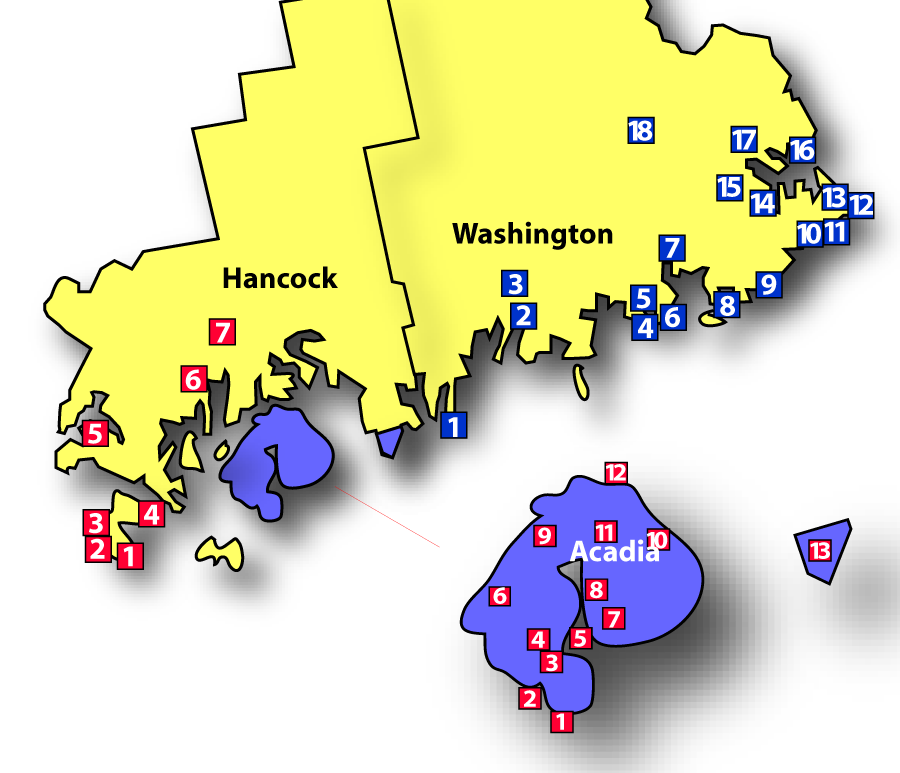
This is a big geographic area.
Hancock County is larger than Rhode Island, and
Washington County is larger than Delaware. The
character of the coast changes in Ellsworth. To the south,
coastal towns foster a thriving tourism industry with many
services and amenities. To the north, the coast is less
developed, while still offering pockets of cultural attractions
and serene villages. The best of both worlds is found around
Acadia National Park.
Hancock County contains
three major peninsulas, two of which enclose Acadia National
Park. There are several preserves that receive light traffic and
provide good birding. Deer Isle and
Stonington essentially mark the southern limit for
Boreal Chickadees and Spruce Grouse.
The middle peninsula extends onto
Mount Desert Island, where the bulk of Acadia National
Park is located. Access to the area from Route 1 is through
Ellsworth along Route 3 to Bar Harbor.
The town bustles with shoppers and sightseers from late April
through October. When these opportunities are combined with the
spectacular beauty of the park, the Acadia area is justly
regarded as an ideal place to bird with families. Walking the
rugged coast, biking the carriage trails, or venturing offshore
for whales allows all family members to experience the beauty
and wildlife of Maine in their own ways.
While
Bar Harbor is notoriously busy in summer, the other side of the
island is locally known as “The Quiet Side.” A gentler pace
persists in Northeast Harbor,
Southwest Harbor, and the nearby villages. Some of the
habitat on Mount Desert Island is still influenced by a
devastating fire that devoured the island in 1947, and took 10
days to control. Dense stands of tall trees are missing from
much of the island, replaced by birches, aspens, and white
pines.
The northernmost
peninsula, Schoodic,, lies north across
Frenchman’s Bay and contains a non-contiguous part of Acadia
National Park. The loop road runs closer to the water than the
road on Mt. Desert Island, making it easier to view sea ducks
from the car. Schoodic Point projects so far into the ocean that
it’s a terrific place to scan for ocean birds. The pounding surf
must sound inviting to Harlequin Ducks, because a few turn up
here every winter. Indeed, storm surges are so powerful that the
roiling ocean can throw bowling ball-sized rocks across the
road. Viewing such a spectacle can be irresistible, but people
have been swept out to sea and drowned here. ALWAYS stay well
out of reach of any surf!
Washington County has
everything except crowds. It would be one of the most heavily
birded areas in America, if America’s birders only knew about
it. The region has every northern forest habitat: mature
hardwood, mixed growth, and thick stands of boreal softwood. It
has fast and slow rivers, marsh and bog wetlands, rocky coasts
and mud flats, grasslands and blueberry barrens. It
has
two national wildlife refuges and one of the best offshore
nesting islands on the east coast. All of Maine’s most highly
sought-after species are found here, sometimes in abundance.
Winter holds pleasant surprises. The
population of sea ducks triples in winter. Bald Eagles are seen
everywhere. In some winters, flocks of American Robins gather by
the hundreds to eat the berries near Quoddy Head State Park in
subzero temperatures. It is the first place to be invaded by
redpolls, Northern Shrikes, and crossbills each December.
Few of the recommended
trails and sites have facilities, so never waste an opportunity
to stop in one of the coastal communities and fishing villages.
This is an area of stark beauty and simple living. Lodging and
dining opportunities are plentiful but not extravagant. Chain
restaurants are few and far between. You won’t miss them.
|